Industrial Cybersecurity for Remote Operations

The operational landscape across Australian heavy industry has fundamentally shifted. Remote Operations Centres (ROCs) in Perth and Brisbane now manage autonomous haulage fleets in the Pilbara and processing plants in the Bowen Basin. Utilities oversee vast distributed distribution networks without resident field personnel, and offshore assets run with increasingly lean crews. While remote operations deliver undeniable gains in safety, plant utilisation, and operational expenditure, they dismantle the traditional physical air-gap that historically shielded critical infrastructure. For engineering managers and asset owners, securing operational technology (OT) across geographically dispersed environments requires moving past basic IT security controls and treating cybersecurity as an essential engineering design discipline.
Replace Flat Network Architectures with Strict Industrial DMZs
The legacy practice of extending corporate wide-area networks (WANs) directly down to programmable logic controllers (PLCs), remote terminal units (RTUs), and human-machine interfaces (HMIs) via standard enterprise tunnels creates an unacceptable blast radius. An initial compromise within corporate email or a third-party contractor’s workstation can lead directly to physical process disruption within minutes.
To establish defensible remote operations, architectures must enforce the Purdue Model through a robust Industrial Demilitarised Zone (IDMZ) at Level 3.5. Direct traffic between enterprise environments (Level 4/5) and the control zone (Level 3 and below) should be strictly prohibited. Actionable implementations include:
- Terminating all external connections inside the IDMZ using protocol-specific jump hosts (such as dedicated RDP or SSH gateways) that break the network session.
- Enforcing unidirectional data flows where control commands are not required. Deploy hardware-enforced data diodes or proxy servers to transmit real-time telemetry, historian data, and alarm logs outward to remote centres without permitting inbound ingress.
- Establishing granular micro-segmentation within remote sites to prevent compromised field devices from communicating horizontally across peer systems.
Enforce Granular, Context-Aware Remote Access Controls
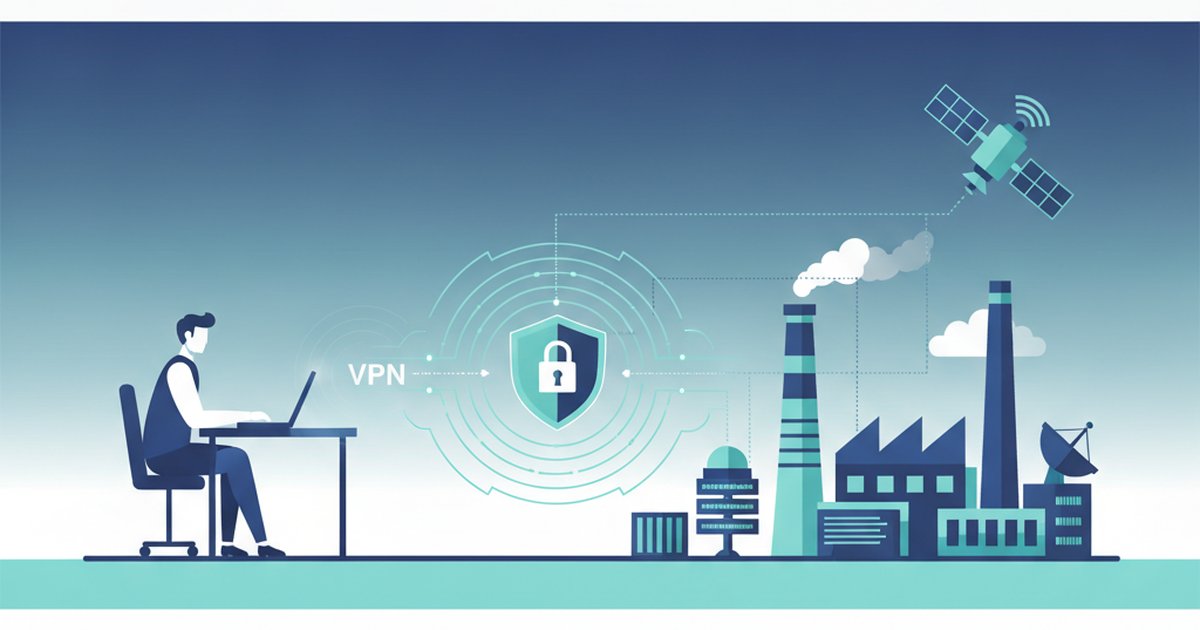
Standard enterprise virtual private networks (VPNs) grant broad, network-level access that violates the principle of least privilege in an industrial environment. Remote access for internal operations personnel, system integrators, and original equipment manufacturers (OEMs) must be strictly constrained by time, identity, and specific asset destination.
Organisations must migrate from persistent broad-access models to Zero Trust Network Access (ZTNA) architectures tailored for industrial controls. Engineering leaders should mandate the following controls:
- Enforce Multi-Factor Authentication (MFA) across all external access pathways, utilising hardware security keys or authenticator applications rather than vulnerable SMS-based verification.
- Implement ephemeral, session-based access controls where external vendor access must be explicitly approved, time-boxed, and tied to an active maintenance ticket.
- Deploy session recording and active keystroke monitoring on all jump servers interfacing with critical process systems, providing non-repudiable audit trails for incident response and regulatory reporting under the Security of Critical Infrastructure (SOCI) Act.
- Ensure control capabilities—such as setting setpoints, updating safety instrumented system (SIS) logic, or flashing RTU firmware—require dual-operator authorisation and are physically restricted by local physical key switches wherever practical.
Deploy Passive Network Visibility and Industrial Threat Detection
You cannot secure systems you cannot see. However, active vulnerability scanning tools native to the IT space often cause legacy PLCs and proprietary industrial communications stacks to fault or crash. Remote assets require non-intrusive monitoring strategies that do not disrupt deterministic control loops.
Asset owners should integrate passive Deep Packet Inspection (DPI) sensors at remote sites via network test access points (TAPs) or mirrored switch ports. Practical deployment focuses on:
- Mapping comprehensive, real-time asset inventories that automatically identify legacy firmware versions, undocumented engineering workstations, and unauthorised cellular modems installed by field technicians.
- Establishing a baseline of normal industrial protocol behaviour (including Modbus, DNP3, EtherNet/IP, and OPC UA) to identify anomalies, such as unexpected read/write commands, off-hours logic modifications, or unusual polling frequencies.
- Backhauling security metadata—rather than full PCAP files, which can saturate low-bandwidth satellite or cellular links common to regional Australia—to a centralised Security Operations Centre (SOC) integrated with OT-specific playbooks.
Formalise Field Incident Response and Failsafe Engineering
When an incident occurs at an unmanned or distantly located facility, relying on rapid on-site human intervention is unrealistic. Incident response procedures must balance cybersecurity containment with process safety and physical asset integrity.
Engineering teams must design operational failsafes directly into the control architecture:
- Incorporate hardware-based manual isolation mechanisms (“island mode” switches) that enable local operators or automated systems to cleanly sever remote WAN links without tripping the plant or shutting down safety instrumented systems.
- Maintain verified, offline golden-image backups of all PLC logic, DCS configurations, and drive parameters, stored both locally at the remote site and securely offsite.
- Regularly execute cross-discipline cyber-physical incident exercises involving both control systems engineers and enterprise cybersecurity teams to test failover behaviours, regulatory breach notifications, and recovery point objectives under simulated network isolation.
Engineering Resilient Industrial Operations
Remote industrial operations represent the future of Australian resources, energy, and manufacturing. However, operational efficiency cannot come at the expense of infrastructure security and safety. Defending remote sites requires an engineered approach that combines deterministic network architectures, zero-trust identity frameworks, and passive visibility aligned with standards such as IEC 62443 and the Australian Energy Sector Cyber Security Framework (AESCSF).
Evaluating and remediating vulnerabilities across distributed operational networks demands specialised expertise across both process automation and enterprise security. To review our industrial cybersecurity assessment methodologies, visit our services page, or reach out to our senior OT engineering team via our contact page to discuss safeguarding your remote operational assets.