
How to Choose a Functional Safety Consultant

In high-hazard industries like mining, oil and gas, utilities, and chemical manufacturing, functional safety is not an administrative checkbox. It is the technical line of defence between normal operations and catastrophic events. Under Australian Work Health and Safety (WHS) legislation, plant owners and operational leaders have a non-delegable duty to eliminate or minimise risks So Far As Is Reasonably Practicable (SFAIRP). When process complexity escalates, relying on in-house teams alone to navigate Australian and international safety standards can expose your organisation to major liabilities. Engaging a functional safety consultant is often essential, but selecting the wrong partner can lead to two costly outcomes: an overly conservative design that chokes operational productivity, or inadequate safety integrity that leaves your facility exposed to regulatory shutdown and disaster.
Demand Verifiable Credentials and Domain-Specific Competence
The term “safety consultant” is broad and largely unregulated in general practice. When procuring services for Safety Instrumented Systems (SIS), you must look for verified functional safety engineer or expert certifications issued by internationally recognised bodies such as TÜV Rheinland, TÜV SÜD, or exida. Credentials such as CFSE (Certified Functional Safety Expert) or FS Eng demonstrate a formal baseline understanding of AS IEC 61508, AS IEC 61511, and machinery safety under AS/NZS 4024.
However, certification alone is insufficient. Theoretical knowledge of mathematical reliability models does not guarantee that a consultant understands how slurry degrades an isolation valve in an iron ore processing plant or how ambient temperatures in the Pilbara affect electronic instrumentation. When assessing prospective consultants, evaluate their direct domain experience:
- Have they delivered functional safety projects in your specific operational environment?
- Can they provide anonymised examples of Safety Requirement Specifications (SRS) and SIL verification calculations they have executed within your sector?
- Do their lead consultants have a background in process control, instrumentation, or systems engineering prior to specialising in functional safety?
Look for Full-Lifecycle Capability, Not Just Workshop Facilitators
Many consultancies can chair a Hazard and Operability (HAZOP) study or lead a Layer of Protection Analysis (LOPA). While structured hazard identification is vital, it represents only the front end of the functional safety lifecycle. A significant risk for asset owners is engaging an advisor who identifies safety instrumented functions (SIFs) and target Safety Integrity Levels (SILs), produces a high-level report, and leaves internal teams with no clear path to implementation.
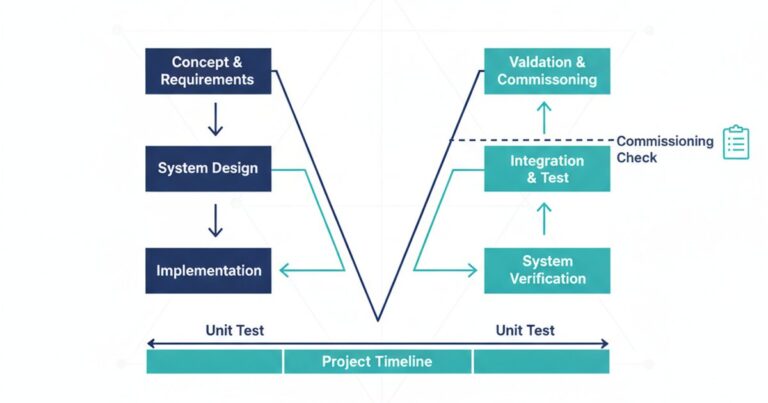
A capable engineering consultancy should demonstrate proficiency across all active phases of the safety lifecycle defined in AS IEC 61511. This includes defining detailed Safety Requirement Specifications, conducting quantitative reliability modeling (calculating Probability of Failure on Demand, or PFDavg), executing Functional Safety Assessments (FSAs Stages 1 through 5), and authoring comprehensive proof-testing procedures. If a consultant cannot guide your engineering team through architecture selection, systematic capability constraints, and hardware fault tolerance requirements, they are delivering half a service.
Prioritise Pragmatic Engineering Over Theoretical Over-Engineering
An inexperienced or overly academic consultant poses a direct threat to your plant’s commercial performance. When consultants lack practical brownfield engineering experience, their default response to risk uncertainty is to over-engineer the solution. They may assign an unnecessarily high SIL target to a loop, mandate complex 2oo3 (two-out-of-three) voting architectures where 1oo2 would suffice, or specify proof-testing intervals so frequent that they disrupt standard production schedules.
Unrealistic safety designs lead to unintended human behaviours on site. When proof-testing is logistically unworkable or spurious trips occur repeatedly, site personnel are tempted to institute permanent bypasses or override safety interlocks, destroying the safety integrity of the plant. The right consultant understands operational realities. They actively seek pragmatic, cost-effective architectures that achieve rigorous risk reduction while preserving operational availability and maintainability.
Insist on Familiarity with Australian Regulatory Frameworks
International standards provide the engineering methodology, but Australian regulatory regimes govern your legal compliance. State-based WHS Acts, Major Hazard Facility (MHF) safety cases, and mining-specific legislation (such as DEMIRS in Western Australia or Resources Safety & Health Queensland) impose distinct statutory duties regarding process safety management.
A capable consultant must bridge the gap between technical standards and legal compliance frameworks:
- They must understand the legal definition and application of SFAIRP under Australian law, recognising that achieving an international SIL target is evidence of risk reduction, but not an automatic defence against statutory duty requirements.
- They should understand how functional safety documentation interfaces with regulators during MHF licensing renewals, safety management system audits, and incident investigations.
- They should deliver defensible, clear audit trails that demonstrate functional safety management processes are active, monitored, and sustained throughout the asset’s operating life.
Making the Final Decision
Selecting a functional safety partner is a high-impact engineering decision. The right consultancy operates as a seamless extension of your internal engineering and operational teams, challenging assumptions, eliminating unnecessary capital expenditure, and ensuring that safety instrumented systems perform reliably when called upon.
Before awarding a contract, look beyond marketing presentations. Interview the specific lead engineers who will facilitate your workshops and review your verification dossiers. Confirm their technical credentials, evaluate their field-level engineering experience, and ensure their philosophy balances rigorous compliance with operational reality.
To learn how our team supports asset owners through every phase of the safety lifecycle, explore our complete functional safety services, or reach out directly through our contact page to discuss your upcoming assessment, audit, or project requirements.